Fonts and Styling for Ebook
Fonts and Styling for Ebook
Once your paragraphs are properly formatted, the next step is to apply basic font and styling rules.
In ebooks, simplicity is what creates the best reading experience.
Use a Standard Font
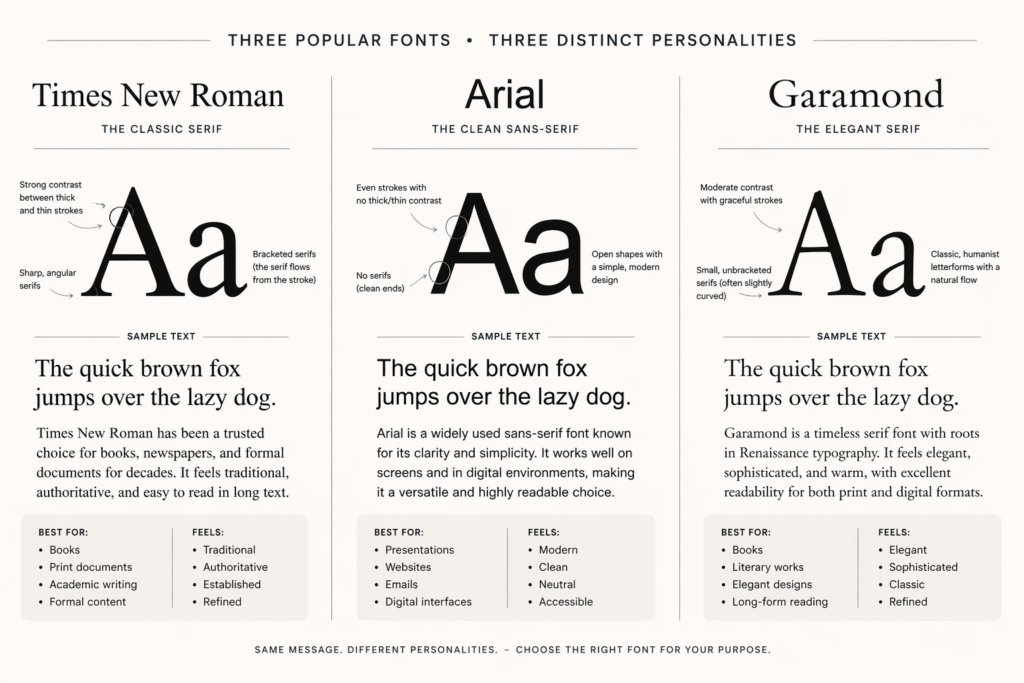
Your manuscript should use a clean, readable font before conversion.
Good options:
- Times New Roman
- Arial
- Garamond
These convert cleanly across most platforms.
Keep Font Styling Minimal
Ebooks are not designed like print books.
✅ Use:
- Bold (for emphasis, sparingly)
- Italics (most commonly used)
❌ Avoid:
- Underlining
- Colored text
- Decorative fonts
Most styling will be overridden by the reader’s device.
Let the Device Control the Font
Readers can:
- Change font style
- Adjust font size
- Switch reading modes
Your job is not to control the font—it’s to make sure your text works with any setting.
Use Italics Correctly
Italics are the most reliable styling option in ebooks.
Common uses:
- Internal thoughts
- Emphasis
- Titles of works
Keep italic usage consistent throughout your book.
Avoid Font Overrides
Some tools allow you to “lock in” fonts.
Do NOT:
- Force specific fonts
- Embed unnecessary font styles
This can create compatibility issues across devices.
Keep Chapter Titles Consistent
Chapter titles should:
- Use the same font
- Use the same size
- Follow the same style
Consistency matters more than design.
Special Characters and Symbols
Use standard characters whenever possible.
Avoid:
- Unusual symbols
- Decorative separators
- Non-standard fonts
These may not display correctly on all devices.
Keep It Simple
The more styling you add, the more chances something breaks.
Simple formatting is the most reliable formatting.
The Goal
Your text should be:
- Clean
- Readable
- Consistent across devices